

Automation as a Service Market Worth USD 92.06 Billion by 2035, Growing at 23.8% CAGR
Automation as a Service Market
Automation as a Service Market Size, Share and Research Report By Service Type (Professional Services, Managed Services), By Deployment Mode (Public Cloud)
Automation as a Service Market is growing as businesses adopt scalable cloud-based automation to improve efficiency and reduce operational costs.”
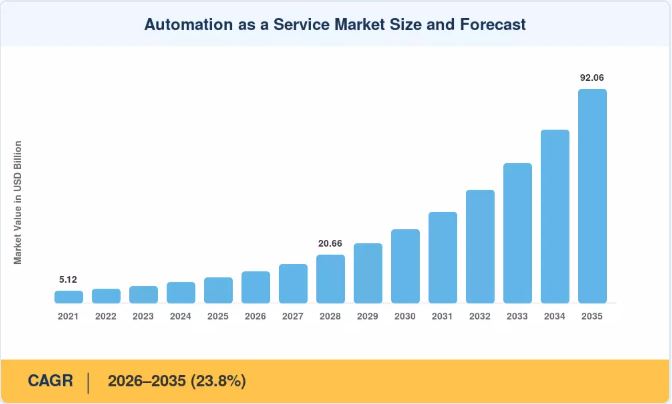
BERLIN, BERLIN, GERMANY, August 25, 2026 /EINPresswire.com/ -- The Global Automation as a Service market reached USD 10.89 billion in 2025 and is projected to grow from USD 13.48 billion in 2026 to USD 92.06 billion by 2035, registering a CAGR of 23.8% during the forecast period 2026–2035. Enterprises across verticals are accelerating their shift from capital-intensive on-premise automation stacks to subscription-based delivery models, driven by the need to compress deployment timelines and align automation spending with measurable business outcomes. — Market Research Future (MRFR)
The convergence of generative AI capabilities with existing robotic process automation deployments has created a step-change in addressable use cases, turning what was once a back-office efficiency tool into a front-office revenue enabler. The market's 23.8% CAGR reflects the convergence of generative AI embedding in automation platforms (25–30% impact), cloud-native infrastructure proliferation (20–25%), low-code and no-code democratization (15–20%), and process mining and event-driven orchestration (10–15%) accelerating across the world's largest enterprise-software and cloud-infrastructure economies simultaneously.
A sweeping technology transformation is underway across the market. Legacy rule-based scripts and siloed desktop bots are giving way to cloud-native orchestration platforms that bundle process mining, intelligent document processing, and event-driven workflow engines into unified stacks. ServiceNow's USD 1.5 billion acquisition of Moveworks in 2024 signaled the scale of vendor investment in conversational AI-powered automation. Low-code design studios now allow business analysts, not just developers, to build, test, and deploy automation pipelines in days rather than months, collapsing the traditional IT bottleneck. North America commanded roughly 40.7% of global revenue in 2025, anchored by early enterprise adoption and deep cloud infrastructure maturity.
Get Full PDF Sample Copy of Report: (Including Full TOC, List of Tables & Figures, Chart) @
https://www.marketresearchfuture.com/sample_request/5551
➤ How Significant Is the Automation as a Service Market's Growth?
The automation as a service market's trajectory from USD 10.89 billion in 2025 to a projected USD 92.06 billion by 2035 represents nearly a nine-fold expansion over the forecast decade, reflecting the structural shift from siloed desktop bots and on-premise scripts toward cloud-native, AI-embedded automation platforms deployed across IT operations, finance, sales, and compliance functions. The market's 23.8% CAGR is anchored in a subscription-and-AI supercycle where generative AI integration, cloud infrastructure proliferation, and low-code democratization are all converging to make automation-as-a-service the default delivery model for enterprise process transformation.
On-premise deployments accounted for 72.1% of market revenue in 2025, reflecting the reality that large enterprises in banking, defense, and healthcare have invested heavily in on-premise infrastructure and face significant switching costs, though cloud-based models are eroding that dominance with a 25.2% CAGR through 2035 as consumption-based pricing aligns costs with actual bot utilization. Solution platforms captured a 70.5% revenue share in 2025, reflecting enterprise preference for integrated suites spanning discovery, build, run, and governance over assembling best-of-breed point tools, while the services segment is growing faster at a 25.1% CAGR as organizations outsource Center of Excellence management and bot maintenance. IT operations held 47.6% of the market in 2025, driven by AIOps and infrastructure automation demand, while sales and marketing automation is the fastest-growing business function at a 24.5% CAGR, propelled by generative AI's ability to personalize content and orchestrate multi-channel campaigns.
➤ What Does the Future Hold for the Automation as a Service Market?
Generative AI embedding in automation platforms contributes approximately 25–30% of driver impact to the automation as a service market's growth the single highest driver impact. The integration of large language models into automation platforms is the single most disruptive accelerant for the market. Microsoft's Copilot Studio, launched in late 2023, enabled enterprises to build AI-powered automation agents without deep coding expertise, and the company reported that over 100,000 organizations had created custom Copilot agents within the first year. This capability transforms automation from structured, rule-based task execution into adaptive workflows that handle unstructured data, emails, contracts, and support tickets, at scale.
Cloud-native infrastructure proliferation contributes approximately 20–25% of driver impact, establishing SaaS delivery as a primary structural demand source. Global enterprise spending on public cloud services surpassed USD 679 billion in 2024, and automation workloads represent one of the fastest-migrating categories, eliminating the infrastructure provisioning lag that historically slowed automation rollouts from months to weeks.
Low-code and no-code democratization adds a further 15–20% of impact as the low-code development platform market exceeded USD 30 billion in 2024, with business-side teams now designing and deploying roughly 60% of new automation workflows without IT intervention according to a 2024 UiPath enterprise survey, expanding the market's addressable base far beyond the IT department into finance, HR, procurement, and customer operations. Process mining and event-driven orchestration convergence contributes a further 10–15%, with Celonis crossing USD 1 billion in annual recurring revenue in 2024 as process mining tools are increasingly bundled with automation orchestration engines to move the market from isolated task-level gains toward end-to-end operational transformation.
The next phase of the market's evolution centers on AI-native autonomous operations, as the distinction between automation and AI largely dissolves within enterprise operations by 2030; AI-augmented automation could unlock USD 4.4 trillion in annual value across the global economy by 2030, with the largest gains concentrated in customer operations, software engineering, and R&D. The market is also consolidating around platform ecosystems analogous to app stores, where third-party developers publish, price, and distribute pre-built automation components, with UiPath's Automation Hub and Microsoft's Power Automate template gallery representing early versions of this model. Sustainability reporting requirements including the EU's Corporate Sustainability Reporting Directive, effective from 2024 and requiring approximately 50,000 companies to produce granular ESG disclosures annually, are creating a substantial addressable segment as manual spreadsheet-based reporting cannot scale to meet regulatory frequency and auditability demands, while data sovereignty laws across over 140 countries are pushing vendors toward sovereign cloud instances and region-specific deployment options.
Get access to the full description of the report @
https://www.marketresearchfuture.com/reports/automation-as-a-service-market-5551
➤ Who Are the Key Players in the Automation as a Service Market?
The automation as a service market exhibits medium concentration, with the top five vendors collectively holding an estimated 38–45% of global revenue. The competitive structure is evolving rapidly as hyperscalers including Microsoft and Google expand platform capabilities that overlap with pure-play automation vendors such as UiPath and Automation Anywhere, with estimated Herfindahl-Hirschman Index values suggesting a market moving from fragmented toward moderately consolidated, driven by M&A activity and platform convergence. MRFR identifies the following key participants with estimated revenue share ranges:
★ UiPath (~10–14% share)
★ Automation Anywhere (~8–11% share)
★ Microsoft (~7–10% share)
★ IBM (~5–8% share)
★ ServiceNow (~5–7% share)
★ Pegasystems (~4–6% share)
★ Appian (~3–5% share)
★ SAP (~3–5% share)
★ Salesforce (~2–4% share)
★ Wipro (~2–4% share)
➤ What Are the Emerging Trends in the Automation as a Service Market?
Several transformational trends are redefining the automation as a service market's evolution through 2035:
Generative AI Embedding in Automation Platforms: Microsoft's Copilot Studio enabled over 100,000 organizations to create custom Copilot agents within its first year, transforming automation from structured, rule-based task execution into adaptive workflows capable of handling unstructured data such as emails, contracts, and support tickets at scale.
Cloud-Native Infrastructure Proliferation: Global enterprise spending on public cloud services surpassed USD 679 billion in 2024, with automation workloads among the fastest-migrating categories as cloud delivery eliminates infrastructure provisioning lag and shortens sales cycles while improving customer lifetime value.
Low-Code and No-Code Democratization: Business-side teams now design and deploy roughly 60% of new automation workflows without IT intervention, expanding the market's addressable base into finance, HR, procurement, and customer operations as the low-code platform market exceeded USD 30 billion in 2024.
Autonomous Agent Ecosystems: AI agents that reason over multiple steps and employ tools are creating a new frontier beyond scripted bots, with early implementations in customer support and IT helpdesk tasks delivering 40–60% reductions in human escalation rates according to Salesforce's 2024 State of Support report.
Embedded Automation in Vertical SaaS: Vertical SaaS platforms for electronic health records or property management are building automation features natively rather than relying on third-party interfaces, opening a distribution channel that circumvents traditional enterprise sales cycles with domain-specific, pre-built workflows.
Buy Full Research Report:
https://www.marketresearchfuture.com/checkout?currency=one_user-USD&report_id=5551
➤ How Is the Automation as a Service Market Segmented?
The automation as a service market report provides a comprehensive segmentation framework:
By Deployment Type: On-Premise (72.1% share, 2025), Cloud (25.2% CAGR)
By Component: Solution (70.5% share, 2025), Services (25.1% CAGR)
By Business Function: IT Operations (47.6% share, 2025), Finance & Accounting (USD 2.18 billion, 2025), Sales & Marketing (24.5% CAGR), Human Resources, Customer Support
By Organization Size: Large Enterprises (75.8% share, 2025), Small and Medium Enterprises (24.8% CAGR)
By End-User Vertical: Telecom & IT (24.1% share, 2025), BFSI (24.2% CAGR), Retail & Consumer Goods (USD 1.47 billion, 2025), Healthcare, Manufacturing, Government, Others
By Region: North America (40.7% share, 2025), Europe (26.0% share, 2025), Asia-Pacific (24.3% CAGR), South America (USD 0.65 billion, 2025), Middle East & Africa (USD 0.69 billion, 2025)
➤ What Are the Regional Insights from the Automation as a Service Market?
North America remains the revenue anchor of the automation as a service market with 40.7% share in 2025, with the United States commanding 78.4% of regional share as early-mover enterprises in financial services, technology, and healthcare have moved beyond pilot-stage automation into enterprise-wide deployment, powered by hyperscaler ecosystem partnerships. Canada contributes 13.2% of regional share as its federal government committed CAD 2.4 billion to IT modernization through 2025, with automation-as-a-service contracts representing a growing share of that allocation, and Mexico holds 8.4% of regional share through its emerging position as a nearshoring hub for U.S. manufacturers, driving demand for supply chain automation and bilingual customer service bots.
Europe's automation as a service market growth, representing 26.0% of global share, is distinctly shaped by regulatory requirements. Germany commands 23.5% of regional share through its Industry 4.0 ecosystem, where the dense fabric of mid-size manufacturers represents an underleveraged opportunity as firms shift from on-premise robotics to cloud-orchestrated production workflows. The UK holds 20.8% of regional share through financial services digital transformation, France contributes 15.4% through government modernization and its national AI strategy, Italy holds 10.1% through SME digitization subsidies, Spain contributes 8.7% through tourism and retail automation, the Nordic countries hold 9.3% through advanced digital infrastructure, Russia contributes 5.1% through energy-sector process automation, and the rest of Europe holds 7.1% through mixed adoption across verticals, with the EU AI Act's risk-tiered framework creating both a compliance cost burden and a competitive moat for platforms achieving early certification.
Asia-Pacific is the fastest-growing region in the automation as a service market at a projected 24.3% CAGR through 2035, driven by massive digital transformation programs and structural labor market shifts. China commands 32.6% of regional share through state-backed AI industrialization, India is posting a 24.9% CAGR within the region as NASSCOM reported Indian IT firms deployed over 500,000 automation bots across client engagements in 2024 alone, positioning the country as both a consumer and global delivery hub. Japan holds 18.4% of regional share as its working-age population declined by over 500,000 in 2024, accelerating enterprise willingness to automate manual processes, South Korea contributes 12.1% through 5G-enabled automation and smart factories, ASEAN is growing at a 21.3% CAGR through mobile-first digital economy expansion, and the rest of Asia-Pacific holds 6.8% of regional share through varied adoption stages.
➤➤➤ Regional & Country-Level Reports by Market Research Future:
US Automation as a Service Market -
https://www.marketresearchfuture.com/reports/us-automation-as-a-service-market-15462
South Korea Automation as a Service Market -
https://www.marketresearchfuture.com/reports/south-korea-automation-as-a-service-market-59043
GCC Automation as a Service Market -
https://www.marketresearchfuture.com/reports/gcc-automation-as-a-service-market-59046
Germany Automation as a Service Market -
https://www.marketresearchfuture.com/reports/germany-automation-as-a-service-market-59044
Japan Automation as a Service Market -
https://www.marketresearchfuture.com/reports/japan-automation-as-a-service-market-59045
India Automation as a Service Market -
https://www.marketresearchfuture.com/reports/india-automation-as-a-service-market-59047
China Automation as a Service Market -
https://www.marketresearchfuture.com/reports/china-automation-as-a-service-market-59048
Spain Automation as a Service Market -
https://www.marketresearchfuture.com/reports/spain-automation-as-a-service-market-59049
Market Research Future
Market Research Future
+1 855-661-4441
email us here
Legal Disclaimer:
EIN Presswire provides this news content "as is" without warranty of any kind. We do not accept any responsibility or liability for the accuracy, content, images, videos, licenses, completeness, legality, or reliability of the information contained in this article. If you have any complaints or copyright issues related to this article, kindly contact the author above.
